A World Without Violence
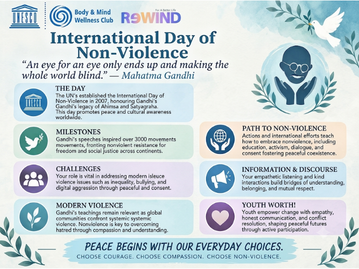
“An eye for an eye only ends up making the whole world blind.” — Mahatma Gandhi
The International Day of Non-Violence is observed annually on October 2 to honor the birthday of Mahatma Gandhi, the leader of the Indian independence movement and a pioneer of the philosophy and strategy of non-violence. Established by the United Nations General Assembly in 2007, this global event aims to spread the message of peace, tolerance, and understanding through public awareness and education. It serves as a universal reminder of the power of peaceful protest, rejecting physical force to achieve social or political change, and reinforces the belief that a culture of peace can build a safer, more just world.
The Legacy of Mahatma Gandhi
Mahatma Gandhi’s life showed that courage can be expressed without violence. Using the ideas of Ahimsa and Satyagraha, Gandhi fought against colonial rule by leading acts of civil disobedience. This proved that ordinary people could stand up against injustice when they work together, stay determined and show courage. Gandhi turned ideas into action with moves such as the Champaran Satyagraha in 1917, which defended indigo farmers, and the Non-Cooperation Movement in 1920, a boycott of institutions. Gandhi’s ideas have crossed borders, inspiring leaders like Dr. Martin Luther King Jr. and Nelson Mandela to seek change. In the end, Gandhi’s legacy reminds us that true strength does not come from defeating others with violence. It comes from standing firm against injustice with courage and compassion.
Violence in Today’s World
Violence is not a phenomenon that is exclusively related to the fringes of society or the war zones of the globe – in numerous ways, it adversely affects the life of people nearby. Whether it takes the form of social inequality, discrimination, school bullying, online harassment, or even the digital aggression we experience daily on social media – it leaves its mark on people and disrupts normal life. However, is there another way to respond to violent actions, disrespectful attitudes, or offensive behaviours besides violent revenge? Constructive communication and a culture of consent help to avoid the negative aftermath of conflicts and allow people to cooperate effectively. Thereby, millions of displaced people around the globe deserve our attention and compassion, as well as an opportunity to engage in a dialogue that would promote peaceful coexistence rather than destruction and aggressive reactions.
The Role of Young People
As children growing up, it’s easy to say that issues like violence, discrimination, and conflict are too big and beyond our control to solve. However, making the world a better and more peaceful place does not mean you have to rally an army. It starts with how we treat our peers and classmates every day. It starts with how we respond to conflicts, and what we say about them to others. It starts with showing a little empathy and respect towards people who may not share our beliefs, as well as not bullying others or calling people derogatory names. We should not forget that what we do online is also a part of our daily lives. If we make thoughtless comments, send mean messages and make cruel posts, these things reach and affect people much faster than you think. Instead, we should use the internet as a place to post kind and empathetic messages and try to raise awareness. Schools are also exciting places for young people to start, where we can learn and practice how to communicate and compromise with each other. We can also learn ways to solve disputes peacefully. You might not be able to change the world just by being a student, however we can all help build the world we want to see for days to come. And it only starts with us.
UNESCO BMW’s Involvement – ReWIND
UNESCO BMW’s ReWIND initiative connects the message of non-violence with emotional well-being, self-awareness and positive communication. Through activities that encourage young people to understand their emotions, manage stress and communicate respectfully, ReWIND shows that peace can begin within ourselves. By learning to respond to disagreements with patience rather than anger and understanding rather than judgement, young people can develop healthier ways of dealing with conflict. In this way, ReWIND supports the wider message of the International Day of Non-Violence: creating a peaceful society begins with individuals who are willing to understand themselves, respect others and choose constructive solutions over aggression.
Ultimately, the UN International Day of Non-Violence is much more than a day dedicated to the birth anniversary of Mahatma Gandhi. It is a day dedicated to our actions, to the choices we make in our daily lives, to the way we react to the problems around us. Gandhi demonstrated to the entire world that it is possible to fight against oppression without resorting to hate and brutality. Today, we must always remember this and remember that every situation requires a decision and action. Be it a dispute with an employer or a hostile meeting at school, we must understand that we can and must strive for peace, even if it is only for our own sake. The youth cannot control everything and change the world around them at will. However, we can start today with decisions that will make our life better and the lives of our loved ones.
Bibliography
Gandhi’s Philosophy of Non-Violence | mkgandhi.org